


GIORZA, PAOLO (1832-1914), musician, was born
on 11 November 1832 in Milan, Italy, son of Luigi Giorza, baritone,
organist and itinerant painter. Having studied first with his father and
Enrico La Croix, at the age of 10 Paolo won a scholarship to the Royal
Conservatory of Music, Milan; Luigi's political activities, however,
forced the family to move to nearby Desio. Eventually Paolo heard
Rossini's Mosé at La Scala, Milan, and his destiny was determined. The
first of Giorza's more than sixty ballets, Il Giucatore, was performed
at Canobbiana theatre in 1853. His next ballet, Un Fallo, opened at La
Scala, in September 1854. He later worked in Venice, Vienna, London and
Paris.
In a concert in late December 1858 Giorza's polka-song La Bella Gigogin
had its première in Milan: it had eight curtain calls. Recognizing its
political significance, the Austrian rulers banned performances of the
song, but it became the rallying cry for Lombardian liberation and was
played when Napoléon III and Victor Emanuel II entered Milan in 1859.
Garibaldi sought battle music from Giorza and the King appointed him
cavaliere, as did King Carlos of Portugal.
Although Giorza's first opera, Corrado, Console di Milano, performed at
La Scala in March 1860, was 'an unmitigated disaster', he remained
devoted to music drama as composer and conductor and was a professional
associate of Rossini, Auber, Meyerbeer, Verdi and Gounod. Giorza's opera
La Capanna dello Zio Tom (Uncle Tom's Cabin) played in Milan in the
mid-1860s. In 1867, as conductor of an Italian company, he travelled to
central and North America. His proposed directorship of the Mexican
Opera was thwarted by the execution of Emperor Maximilian; Giorza went
to the United States of America. There he wrote a suite of incidental
music for the soprano Adelaide Ristori's 1867 season of Giacometti's
Marie Antoinette.
In 1871 Giorza arrived in Australia as music director of a small opera
ensemble, the Agathe States group, which gave performances in Sydney in
December and at the Princess Theatre, Melbourne, in February 1872. He
remained in Australia, employed by W. S. Lyster and then the
Lyster-Cagli company. Later he worked with J. C. Williamson's English
Opera Company and the Pompei-Lazar and Lazar Royal Italian companies.
His broad repertoire encompassed Verdi and Gilbert and Sullivan;
contemporary reviewers praised his versatility and the fluidity of his
direction. Described as Australia's then 'leading score doctor', he
frequently wrote songs for interpolation into performances. All this
time he was teaching (including the organ in Adelaide), composing
(especially religious music) and directing music (at St Francis's
Church, Melbourne, in 1873-74 and later at St Patrick's, Sydney).
In Sydney in late 1874 his Catholic connexions developed, especially
with (Sir) Patrick Jennings. Giorza rejoined forces with Ristori and
directed the orchestra for Ilma di Mirska's concerts in the mid-1870s.
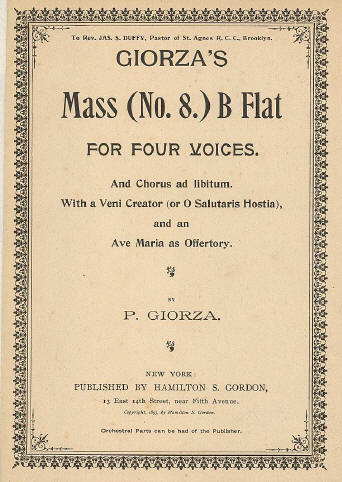
Several of his masses were performed and in 1875 he conducted the Sydney
première of Verdi's Requiem and his own Cantata for the Daniel O'Connell
centenary celebrations, in the presence of Ristori and Archbishop
Polding. Jennings, a passionate music-lover, chose Giorza as director of
music for the Sydney International Exhibition of 1879-80. The
appointment generated protest, especially from Sydney's resident
professionals who feared, needlessly, exclusion from the musical
programme. They also resented that Giorza (with Henry Kendall providing
the text) was commissioned to compose the grand celebratory opening
cantata. This he did with great success. It was scored for a large
chorus and children's choir, a demi-chorus, soloists and a full
orchestra, 'comprising every musician of note in the city', which
incorporated the organ and eight pianists, one of them the composer's
wife Luiga.
During the exhibition, Giorza also provided daily concerts, some of them
grand orchestral and choral occasions, with Handel's oratorios prominent
as well as band and chamber music and piano recitals. Frequently, Giorza
was the soloist, especially on the second-hand, 'asthmatic, little'
English organ that had been purchased for the Garden Palace, although he
failed to play one hour per day as stipulated in his contract, which
Jennings threatened to terminate. Giorza survived to perform at the
closing ceremony in April; during the interminable presentations, he
improvised on the national songs of the participant nations—with the
conspicuous omission of Austria.
In July 1883 Giorza invited Sir Henry Parkes to a farewell concert,
after which he departed for Europe. There he published his book of dance
music, Souvenir d'Australia (Milan, 1884), and secured some
performances, including his last ballet, Rodope, which opened at La
Scala on 5 January 1892. Then, presumably for financial reasons, he
returned to the U.S.A. A report in the American Catholic Standard in
March 1902 mentioned that he was in Philadelphia for a performance of
the first of his nine masses but in 1906, having lost most of his scores
in the fires which followed the San Francisco earthquake, he moved to
Seattle, where he continued to teach but became impoverished. An
obituarist described him as 'a sturdy figure of a quaint old man with a
splendid halo of white hair'. He died on 4 May 1914 in a boarding-house
at Seattle. After a service at St Benedict's Catholic Church, he was
buried in Calvary cemetery, the grave and funeral costs being paid for
by Ambrose Chiappa.
Although he was an internationalist, Giorza's career illustrates the
richness of Australian intellectual and cultural life before Federation.
He was, with Isaac Nathan, the most significant musician to work in
Australia during the nineteenth century.
Select Bibliography
F. Savio, Enciclopedia dello Spettacolo, vol 5 (Rome, 1958); A. Gyger,
Civilising the Colonies (Syd, 1999); Dizionario Biografico Degli
Italiani (Rome, 2000); P. Proudfoot, R. Maguire, R. Freestone (eds),
Colonial City, Global City (Syd, 2000); Sydney Morning Herald, 26 Dec
1878, p 5, 29 Mar 1879, p 6, 13 May 1879, p 5, 20 May 1879, p 5, 23 May
1879, p 7, 24 May 1879, p 3, 21 Apr 1880, p 10, 21 Apr 1880, p 9;
Post-Intelligencer (Seattle), 5 May 1914, p 1; Seattle Times, 30 Mar
1961, p 30; Giorza music collection (Veech Library, Catholic Institute
of Sydney); newspaper cuttings, vols. 188-89 (State Library of New South
Wales); concert programmes, Sydney International Exhibition, 1879-80
(State Library of New South Wales).
Author: John Carmody
Print Publication Details: John Carmody, 'Giorza, Paolo (1832 - 1914)',
Australian Dictionary of Biography, Supplementary Volume, Melbourne
University Press, 2005, pp 143-144.
|
> 3000 Ave Marias -- Songs of Sharon -- Remi Ghesquiere -- St-Basil's Hymnal -- PROJIMO -- Computer Games |




 avemariasongs.org